
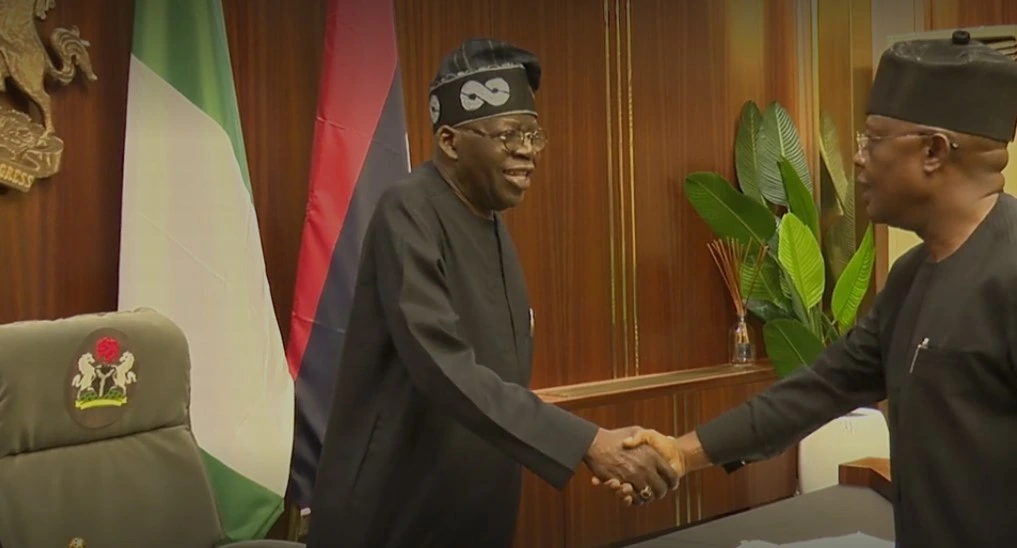

National Assembly legislators approve President Bola Tinubu’s emergency rule and suspension of elected officials in Nigeria’s Rivers State. Yesterday, 20 March 2025, both Senate and House of Representatives approved the president’s emergency declaration to give it constitutional backing.
The 243 House of Representatives members in attendance approved the measures through a voice vote ordered by Speaker Tajudeen Abbas. This method saved members from personally disclosing their voting preferences. It also prevented the House from verifying that two-thirds of members supported the President’s action. In pushing through the plan, Speaker Abbas disallowed efforts by opposition legislators to do a headcount of attendees. Legislators in the Senate toed a similar line to also approve Tinubu’s declaration of emergency rule in Rivers State.
The president had argued that the measures addressed concerns over political instability and threat to oil infrastructure in Rivers State. Attorney-General Akin Olujimi, a senior lawyer, blamed Governor Fubara for not doing enough to halt the chaos in his state.
What the legislators approved
The House approved President Tinubu’s emergency rule and the six-month suspension of the Governor, deputy governor, and State Assembly. Members also voted to raise a committee of eminent personalities to broker peace in the State. Finally, it voted to assume the functions of the State House of Assembly for the six-month emergency period.
Similarly, the Senate approved the emergency rule and the constitution of a peace committee through a voice vote . It also voted for a joint ad hoc committee from both houses to oversee lawmaking in Rivers State during the period. Section 11(4) of the Nigerian Constitution grants the Assembly powers to make laws for a state under emergency rule.
An Administrator takes over Rivers
Tinubu administered oath of office on Vice Admiral Ibok-ete Ibas, a retired naval chief, as Sole Administrator of Rivers State. This happened few hours after announcing the appointment in same broadcast where he invoked emergency rule in the oil-rich State.
In his Tuesday, 18 March 2025 broadcast, President Tinubu defined the functions of the administration thusly:
“The Administrator will not make any new laws. He will, however, be free to formulate regulations as may be found necessary to do his job, but such regulations will need to be considered and approved by the Federal Executive Council and promulgated by the President for the state.”
The public widely criticized the statement because it ceded the power to make laws in the Executive, rather than the National Assembly. In response, the National Assembly voted yesterday to raise a committee to make laws for the suspended Rivers State Assembly.
What the people are saying
Before the voting took place, there were fears that legislators may resort to voice votes to approve emergency rule.
A banker and investor, Mr. Atedo Peterside, argued in X (formerly Twitter) that a voice vote will not cut it. “A two-thirds majority cannot be achieved via a voice vote. Members voting for or against the resolution to ratify the President’s emergency actions must identify themselves and cast their votes individually.”
After the votes, however, opinions diverged, with the presidency and members of the ruling party praising the decision.
Government is happy…
Federal public officials did all they could to explain and justify the decision to impose emergency rule in Rivers. The President, the attorney-general, and FCT minister Nyesom Wike gave spirited responses to justify the imposition.
President Bola Tinubu offered fulsome praise to the National Assembly for ratifying his declaration of emergency rule in Rivers State. He described the support as “decisive and patriotic …. “a critical step to restoring stability after a protracted political crisis.” The crisis, he said, “paralyzed governance … and endangered national economic security for over 15 months.”
Imo State Governor, Hope Uzodimma, spoke to journalists in Owerri and commended the National Assembly for supporting President Tinubu’s decision. He described the action taken by the legislators to approve emergency rule in Rivers State as “a step taken in the national interest.” According to him, “the President was very proactive, and his actions are highly commendable. Prevention, they say, is better than cure. Imagine what would have happened if (Fubara’s) impeachment went ahead. It would have triggered actions and reactions, leading to violence and widespread unrest,”
… and the people are unhappy
The National Assembly’s decision failed to halt criticism of both the executive and the legislature. Legal experts and opposition figures maintained that it is overstepping constitutional boundaries to suspend elected state officials. They also knocked the decision of the National Assembly to use voice votes to approve the President’s emergency rule declaration.
Former PDP Chairman, Audu Ogbe, faulted the use of voice votes by legislators to approve emergency rule in Rivers State. He described it as a ruse. “Ayes and nays do not give us a clear picture of the position and the moral authority of individual senators or members of the House,” he told Channels TV.
“Nobody should hide under a shadow – if you want a vote, say so; if you don’t want it, say so but this ayes and nays is a camouflage, it doesn’t work.” Ogbe advised the Assembly to adopt individual voting on crucial bills and motions. This was the case when he served as deputy speaker in the Benue House of Assembly. “I would like to suggest to the National Assembly to install a capacity in the future for individual voting which they can print out; not ayes and nays, because someday, 10 to 20 years from now, their children and grandchildren and researchers would like to find out how individuals voted on particular bills.”
Former Governor Peter Obi roundly condemned the National Assembly’s resort to voice votes to approve emergency rule. He said that the legislators “added salt to injury by using a voice vote to pass the illegality.” According to him, it disregards constitutional requirements, erodes public trust, and calls to question the “transparency and integrity of the National Assembly.” “It is disheartening that a decision as crucial as approving an emergency proclamation—one that could alter the course of the nation—has been handled with such casual disregard for constitutional standards. The 1999 Constitution of Nigeria (as amended) clearly requires that at least two-thirds of all members of each House must approve the proclamation …A voice vote for such a critical matter is not just insufficient; it’s a dangerous precedent. Today, it’s a voice vote on a state of emergency. Tomorrow, it could be a voice vote on citizens’ fundamental rights.”
Two Senior lawyers who spoke to Vanguard newspaper expressed disappointment that legislator’s used voice votes to approve emergency rule.
Prof. Sam Erugo, a senior advocate, said the legislators “did not appreciate the gravity of the President ‘s proclamation. Section 305(2) of the Constitution requires the legislature to ‘consider the situation and decide whether or not to pass a resolution approving the Proclamation.’ Subsection (6) enables the proclamation to lapse after two days if the National Assembly fails to muster a two-third majority vote. This provision shows the seriousness of the matter the National Assembly treated just like any other business.
“A voice vote is insufficient to pass the resolution approving the President’s proclamation. It requires a special resolution and, obviously, the voice vote is unconstitutional. There is no way to determine that two-thirds majority ‘of all the members’ voted in favour of the proclamation.” He decried the hurry to approve the declaration which robbed the nation the opportunity to watch robust debates. The public would have used the debates to judge the propriety of declaring emergency rule and suspending elected officials.
Another senior advocate, Kunle Edun, suggested that the legislators should follow physical or electronic voting and counting of the votes. “Voice voting does not guarantee fairness and transparency as shown in previous sessions presided over by the Senate President particularly. The National Assembly can establish fairness in the exercise through electronic or physical voting that shows how each senator voted.
Conclusion
The approval of emergency rule by both the Nigerian Senate and House of Representatives draws a curtain on the matter. However, it fails to settle the question of whether the President’s and the Assembly’s actions are constitutionally valid and legal. This debate will continue for the forseable future.
Join the Conversation
Do you have an opinion on this issue? Share your thoughts below with readers of Enugu Metro, the only medium that focuses on news that matter.